How Were Medieval Shield Wooden Cores Constructed?
A cautious evidence-status article on Szczecin, Seedorf, and Marburg shield cores: what is proven, what is interpreted, and what remains unknown.
When people imagine a medieval shield, they usually picture the painted face: heraldry, colour, scars, a bold outline. But underneath that visible surface was the part that made the object a shield in the first place: the wooden core.
For Shieldwright, this is not a decorative question. If we want to build historically informed shields, we first have to ask what the surviving evidence actually says about the wood: which species were used, how many boards or planks formed the body, how thick they were, how the edges met, and what remains unknown.
The answer is already more interesting than a simple recipe. The surviving evidence does not point to one universal medieval shield core. It points to several real construction choices: thin alder planks at Szczecin, bevelled alder boards at Seedorf, and linden construction in the Marburg shields. Some details are strongly supported. Others are still disputed or known only through secondary reports.
The Short Answer
The best current evidence suggests that some 12th- and 13th-century European shields were made from multiple solid wooden planks or boards set side by side. Alder is strongly documented in the Szczecin and Seedorf shields. Linden is documented for the Konrad von Thuringia shield at Marburg.
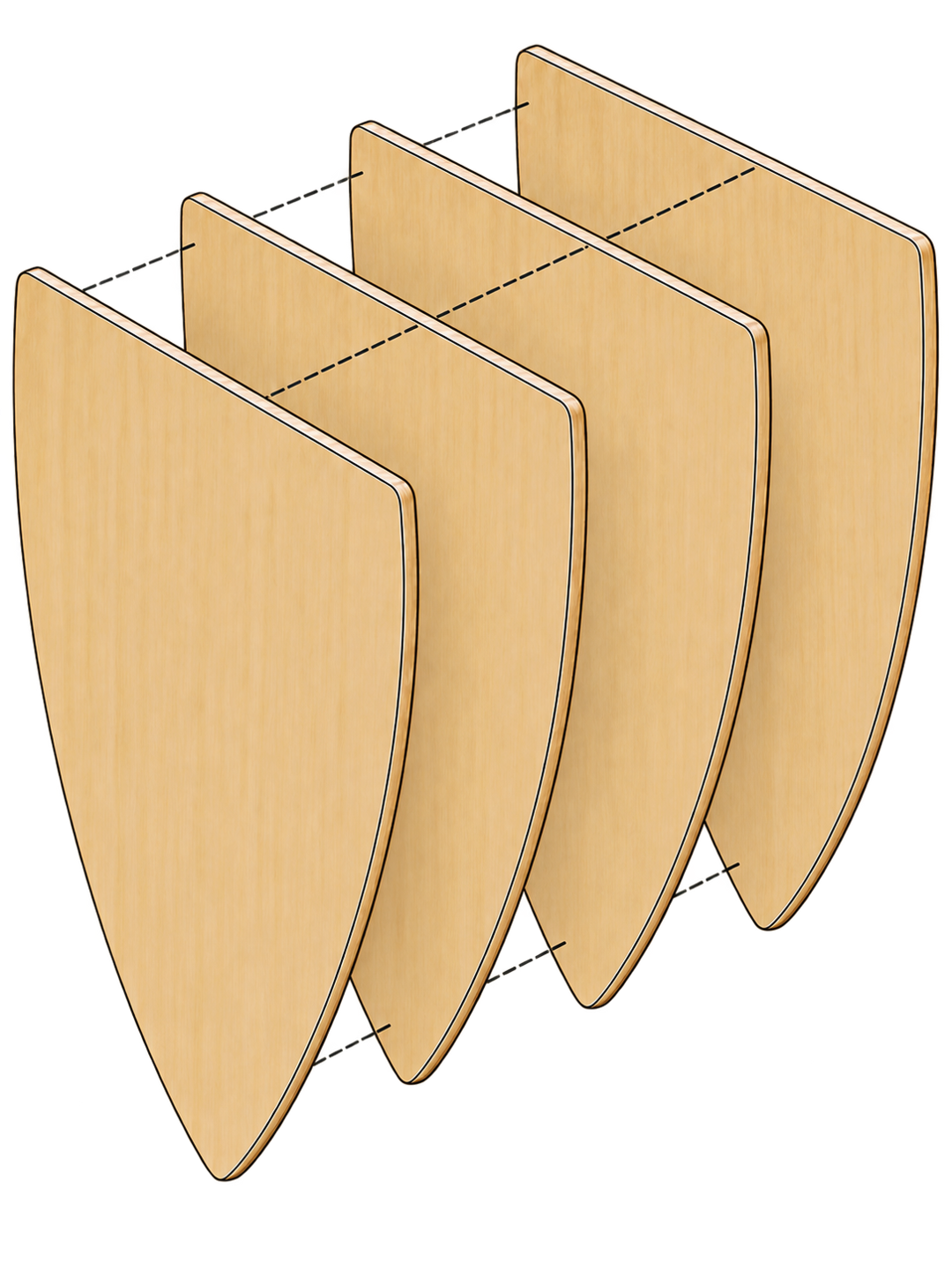
- the painted Szczecin shield was made from thin alder planks, but the exact plank count is disputed between six and seven;
- the second Szczecin shield preserves two alder planks, with an estimated original total of about five;
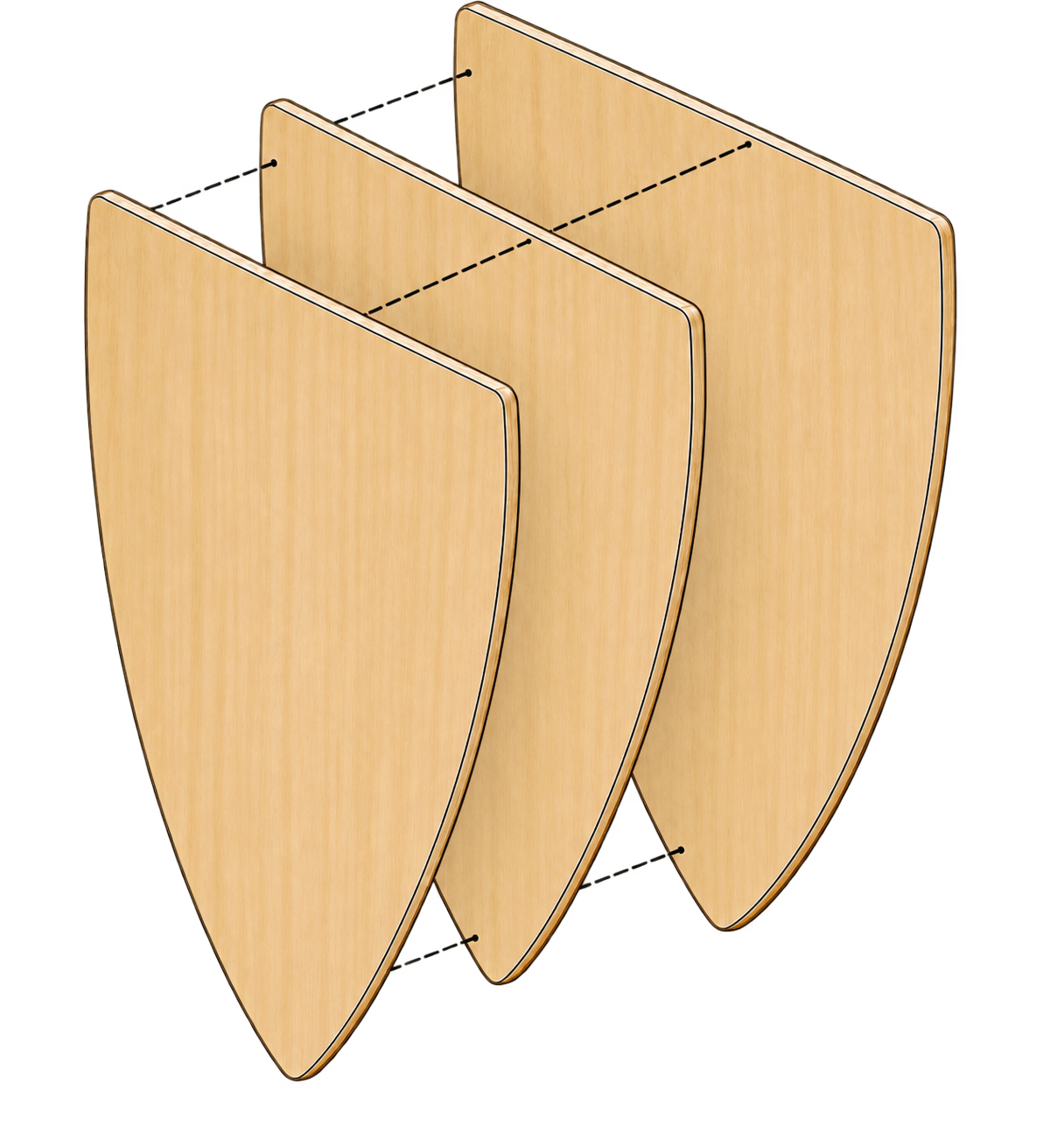
- the Seedorf shield used four lengthwise alder boards with bevelled, edge-glued joints;
- the Konrad von Thuringia shield at Marburg is catalogued as linden, while its reported board count and thickness remain source-qualified.
This is enough evidence to reject a vague idea that medieval shields were simply generic wooden boards. It is also not enough evidence to publish a single universal formula for all medieval shields.
Evidence Categories Used Here
Szczecin: Thin Alder Plank Construction
Two 12th-century kite shields from Szczecin, Poland, are among the most important surviving pieces of evidence for early medieval wooden shield construction. They are especially valuable because they are actual archaeological finds, not later artistic depictions or modern reconstructions.
The painted Szczecin shield is dated to the late 12th century. The current National Museum in Szczecin catalogue dates it to 1176-1200. The shield is made from alder and preserves evidence for a one-layer side-by-side plank structure. The individual planks are narrow and thin by modern expectations: approximately 6-17 cm wide, with thickness reported around 4-8 mm depending on source.
The Second Szczecin Shield
The second Szczecin shield is less complete, but it helps prevent another mistake: assuming that all shields from the same context had one fixed board thickness or plank count.
Only two planks survive. Dowen et al. give the surviving length as 97 cm. The two surviving planks are recorded as 13.8 cm and 12.2 cm wide, with thickness around 7.5-9 mm. The wood is again alder, identified by microscopic analysis.
Seedorf: Bevelled, Edge-Glued Alder Boards
The Seedorf shield, associated with Arnold von Brienz and dated around 1200-1220 in the Shieldwright notes, is one of the strongest comparisons for early 13th-century shield construction. It is especially important because it does not simply duplicate the Szczecin pattern.
The Seedorf core is recorded as four lengthwise alder boards. The mating edges were bevelled to increase the bonding surface, and the construction is described as edge-glued. This is a different joint geometry from the right-angled plank edges reported at Szczecin.
Marburg: Linden, But Qualified Claims
The shield of Landgrave Konrad von Thuringia at Marburg, inventory 3177, is central for early 13th-century heraldic shield evidence. It is dated around 1230/1240 and belongs to a very important Marburg group.
The current institutional record identifies linden wood, leather, chalk ground and polychromy. It gives the dimensions as 88 x 72.5 cm. Those material and object-identification details are strong evidence.
The more detailed wooden-core claims are less secure. Secondary technical literature reports seven to eight linden boards and about 10 mm thickness, with the board count explicitly visibility-qualified. Older Warnecke-attributed wording reports 10-12 mm thickness and split/core-derived linden, but the relevant Warnecke 1884 pages have not yet been directly read in the current research archive.
What The Evidence Does Not Prove
The strongest lesson from these shields is variation. The evidence does not support one universal medieval shield-core formula.
It does not prove that every 12th- or 13th-century shield used alder. Marburg points strongly to linden. It does not prove that every shield used the same number of boards. Szczecin, Seedorf and Marburg each point in different directions. It does not prove one standard thickness. Even the two Szczecin shields differ.
What This Means For Shieldwright Reconstruction
For workshop purposes, the evidence suggests several practical test paths rather than one finished answer.
A Szczecin-inspired experimental core would reasonably test thin alder planks, square/right-angled mating edges and a side-by-side arrangement, while keeping the six-vs-seven plank issue visible. Such an experiment should not be advertised as the exact original Szczecin construction unless the unresolved plank-count contradiction is later explained.
A Seedorf-inspired experimental core would reasonably test four alder boards with bevelled mating edges and structural edge-gluing. This is one of the clearer surviving examples for joint geometry, though the adhesive chemistry still remains a separate question.
A Marburg-inspired experimental core should be more cautious. Linden is well supported, but board count, thickness and joining need source-qualified handling. It may be practical to test linden boards around the reported thickness range, but the result would be a Shieldwright reconstruction hypothesis, not a proven Marburg recipe.
The most historically honest approach is not to ask, "What was the medieval shield core?" but "Which construction is best supported for this object, date, region and shield type?"
Provisional Construction Comparison
| Object | Date | Wood | Boards / planks | Thickness | Joining evidence | Confidence |
|---|---|---|---|---|---|---|
| Painted Szczecin kite shield | Late 12th c.; museum 1176-1200 | Alder | Six in 2009/10 and current museum catalogue; seven in Dowen et al. 2019 | Approx. 4-8 mm, source-dependent | Right-angled side-by-side planks; no dowels/laps/dovetails; glue reported or inferred | HIGH for wood and construction family; CONFLICTED exact plank count |
| Second Szczecin kite shield | 12th c. | Alder | Two surviving; about five original is an estimate | 7.5-9 mm surviving | Right-angled edges; exact joining unknown | HIGH surviving data; MEDIUM reconstruction estimate |
| Seedorf / Arnold von Brienz shield | Around 1200-1220 | Alder | Four lengthwise boards | Approx. 15 mm bare-core figure remains source-qualified | Bevelled mating edges; edge-glued | HIGH for wood, board count and joining; MEDIUM for bare-core thickness |
| Konrad von Thuringia, Marburg 3177 | c. 1230/1240 | Linden | Seven to eight, visibility-qualified secondary observation | About 10 mm in Kohlmorgen; 10-12 mm Warnecke-attributed | Joining geometry unknown | HIGH for linden; MEDIUM for board count and about 10 mm; MEDIUM/HIGH for Warnecke-attributed 10-12 mm until direct pages are recovered |
Conclusion
The surviving evidence shows that medieval shield cores could be carefully made multi-board structures, not crude slabs hidden under paint. But the evidence also resists a single answer.
Szczecin gives us thin alder plank construction with square internal edges and an unresolved six-vs-seven plank contradiction. Seedorf gives us four alder boards with bevelled, edge-glued joints. Marburg gives us linden and an important early 13th-century heraldic shield, but its board count, thickness and joining details still need direct primary verification.
For Shieldwright, that is a strong beginning. We can build historically informed experiments from this evidence, but we should keep the labels visible: what is proven, what is interpreted, what we choose to test, and what we still do not know.
That honesty is not a weakness in the reconstruction. It is the point.
Bibliography / Source Base
- Muzeum Narodowe w Szczecinie. Tarcza drewniana, MNS/A/22250/1, digital collection.
- Dowen et al. 2019. Keith Dowen, Lech Marek, Slawomir Slowinski, Anna Uciechowska-Gawron and Elzbieta Myskow, Two Twelfth-Century Kite Shields from Szczecin, Poland, Arms & Armour 16:2 (2019), 121-148, DOI 10.1080/17416124.2019.1667049.
- Glosek and Uciechowska-Gawron. Wczesnosredniowieczna tarcza z podgrodzia w Szczecinie, Materialy Zachodniopomorskie NS VI/VII, 269-283.
- Jagielska. Badania i konserwacja drewnianej tarczy ze szczecinskiego Podzamcza, Materialy Zachodniopomorskie NS VI/VII, 285-298.
- Senn and Moser. Der Reiterschild von Seedorf UR: ein Untersuchungs- und Restaurierungsbericht, Jahresbericht Schweizerisches Landesmuseum 100 (1991/1992), 80-85.
- Bildindex / Bildarchiv Foto Marburg. Schild des Landgrafen Konrad von Thuringen, inventory 3177.
- Warnecke 1884. Friedrich Warnecke, Die mittelalterlichen heraldischen Kampfschilde in der St. Elisabeth-Kirche zu Marburg (Berlin, 1884), not yet directly recovered in the current source archive.
- Nickel 1958 / 1959-60. Helmut Nickel, Der mittelalterliche Reiterschild des Abendlandes, FU Berlin dissertation 1958 / Der Herold offprint 1959/60, not yet directly recovered in the current source archive.