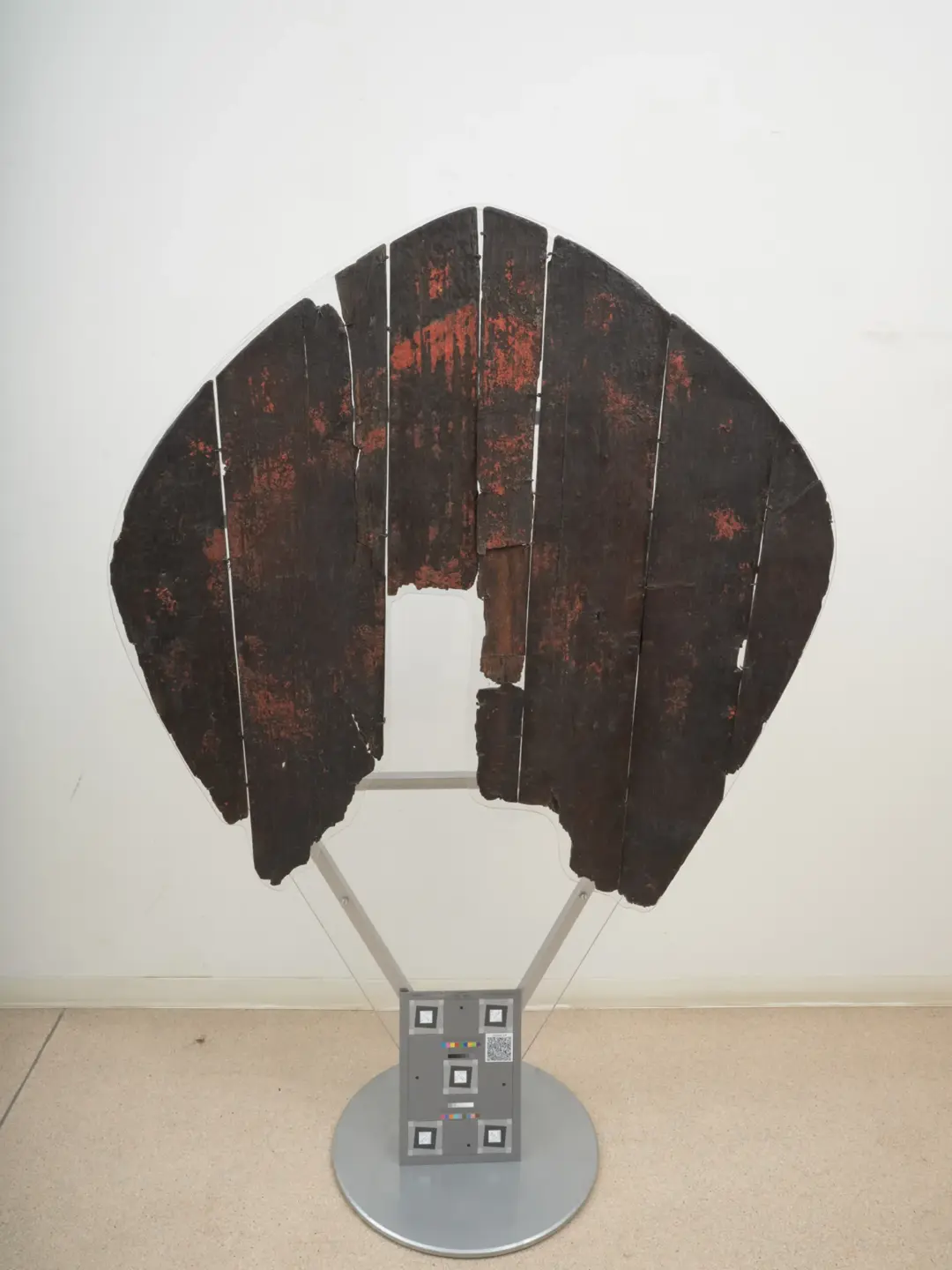
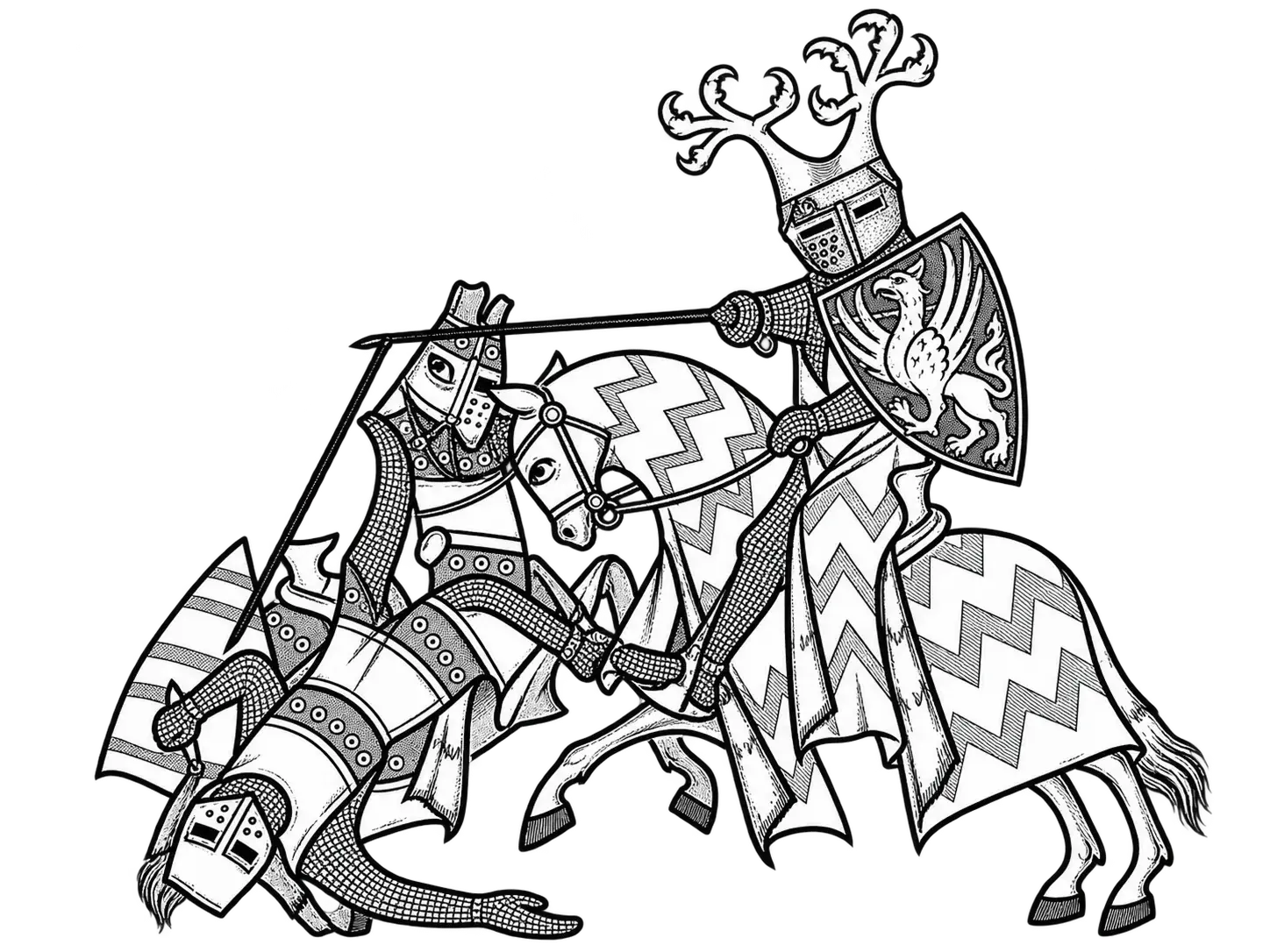
Parchment, leather, paint and bare wood all appear in the evidence, but surviving shields do not support one universal medieval facing recipe.
Date
2026-09-09
Read
10 min read
Status
Research article
A medieval shield was not just a wooden board with heraldry painted on it. Between the timber core and the visible surface there might be parchment, leather, hide, chalk ground, paint, or sometimes no clearly documented full facing at all.
That makes the covering question more difficult than it first appears. A surviving shield can preserve wood species, board construction, painted decoration, a front preparation layer, a rear covering, later repairs and museum restoration history in the same object. Those layers must not be collapsed into a single recipe.
The current evidence points to variation. Seedorf and Marburg make parchment a serious high-medieval shield-facing material. Seedorf also preserves evidence for leather on the reverse, but its exact rear stratigraphy remains unresolved. Szczecin is important because the published and institutional evidence does not let us confidently impose the same parchment/leather package on every 12th-century shield.
The Short Answer
The safest answer is that some 12th- and 13th-century European shields were covered or prepared with parchment, leather or hide-related materials before painting, while the exact layer sequence varied by object. The evidence does not support one universal covering method for all medieval shields.
Seedorf is strong evidence for a parchment-faced, chalk-ground and painted high-medieval shield, with additional rear leather evidence that must be handled separately;
the Marburg Konrad shield is institutionally documented as linden wood with leather, chalk ground and polychromy, while detailed two-sided parchment claims remain source-qualified unless primary wording is checked directly;
the Szczecin painted shield is strong evidence for a plank-built painted shield, but its exact surface preparation and the basis for any direct-on-wood claim must remain carefully qualified;
the late-13th-century Alfonsine text directly connects hide covering and cheese glue with strengthening shields, but it is textual evidence rather than object analysis.
Parchment, leather and hide are historically serious shield materials. They are not a licence to flatten every surviving object into the same construction.
How To Read The Evidence
This article uses the same evidence categories as the earlier Shieldwright construction articles. They are important here because a material named in a museum record, a layer observed by a conservator, a later antiquarian description and a workshop reconstruction are different kinds of claim.
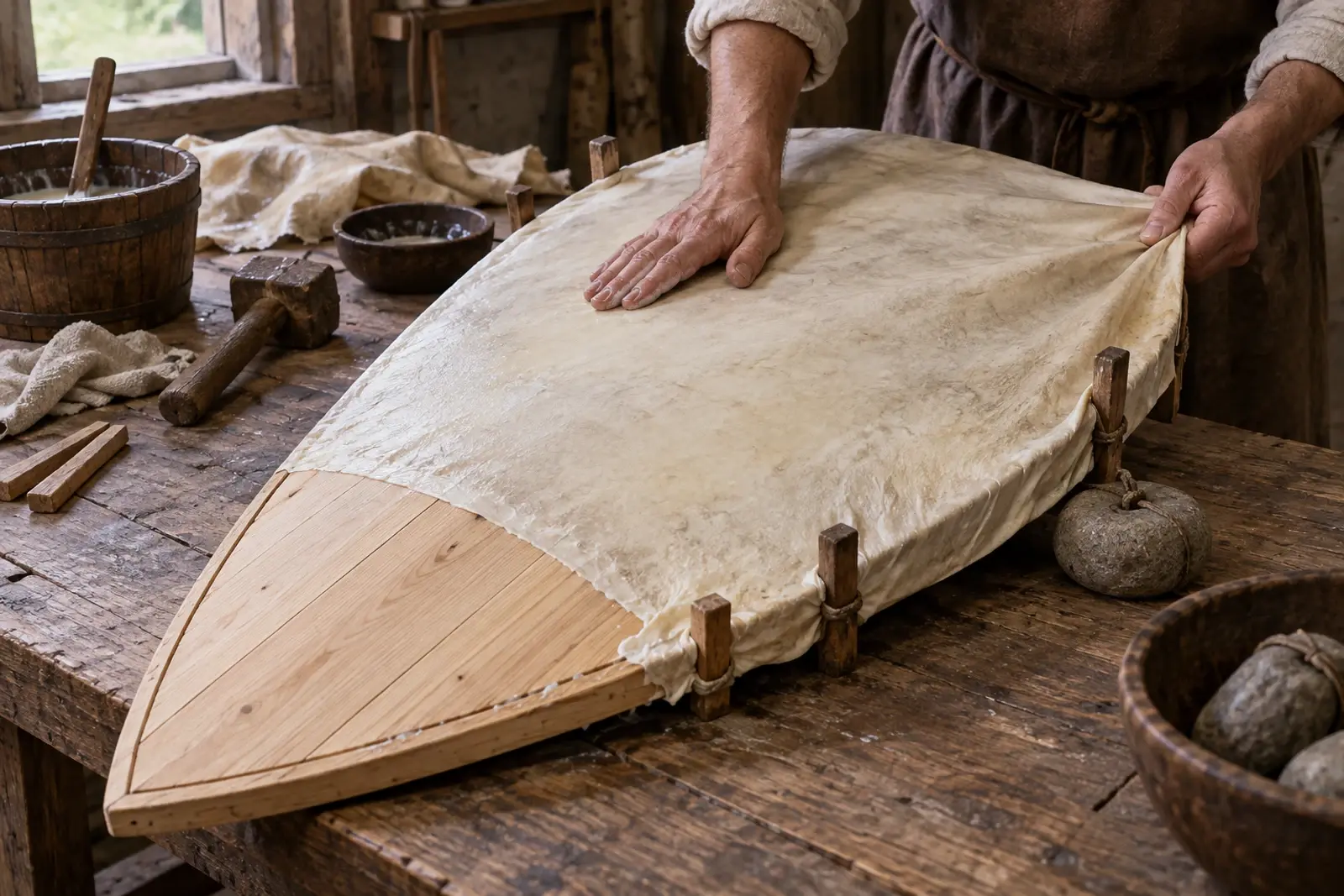
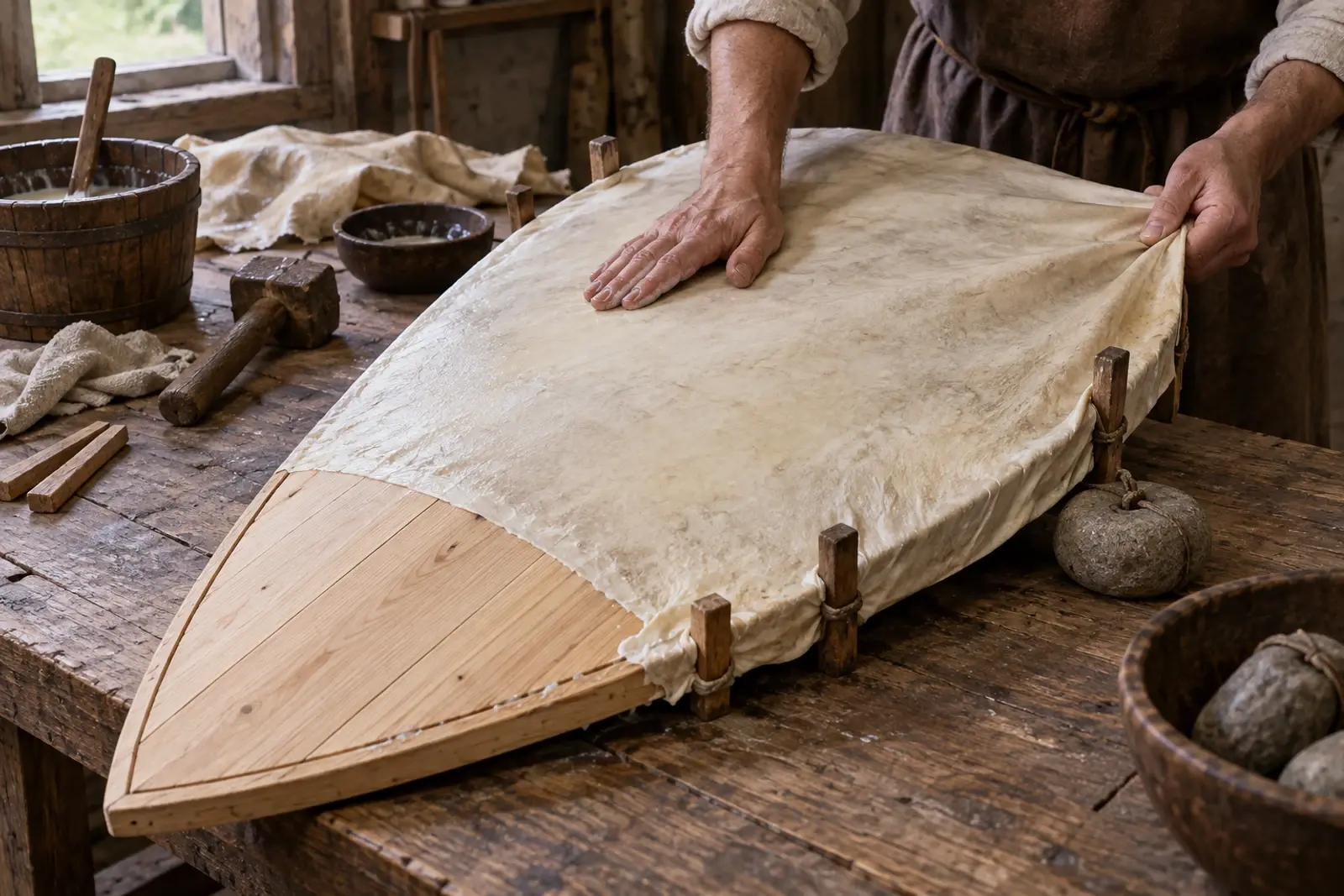
Explanatory reconstruction of a parchment or rawhide facing being applied over a wooden shield core. This illustrates one historically plausible covering process; it is not a photograph of a surviving object and should not be read as a universal medieval recipe.Image: Shieldwright explanatory illustration. Generated specifically for this covering article.
Seedorf: Parchment In Front, Leather On The Reverse
The Seedorf / Arnold von Brienz shield, usually dated around 1200-1220, is one of the strongest target-period objects for the covering question. It matters because its surface evidence is richer than a simple statement such as "wood covered with leather".
Marburg: Strong Material Record, Qualified Layer Claims
The shield of Landgrave Konrad von Thuringia at Marburg, inventory 3177, is another central 13th-century comparison. It is not a construction twin of Seedorf, but it shows that shield surfaces could be technically sophisticated: wood, organic covering, ground and polychromy belong to the same object history.
Szczecin: Do Not Import A Covering Recipe
The painted Szczecin shield is valuable because it checks our temptation to turn Seedorf and Marburg into a general rule. It is a late-12th-century archaeological shield with alder plank construction and painted decoration, but the accessible evidence does not yet justify assigning it the same parchment/leather surface package as the high-medieval heraldic shields.
A Thirteenth-Century Textual Clue
Surviving objects are the anchor, but period texts can show which craft ideas were available in the medieval world. The Alfonsine astronomical material gives one especially relevant comparison because it explicitly mentions shields in relation to hide covering and strengthening.
Where Does Linen Fit?
Modern shield reconstruction often uses linen because it is available, strong, paintable and practical. Those are real workshop advantages. They are not, by themselves, direct evidence for a specific 12th- or 13th-century shield facing.
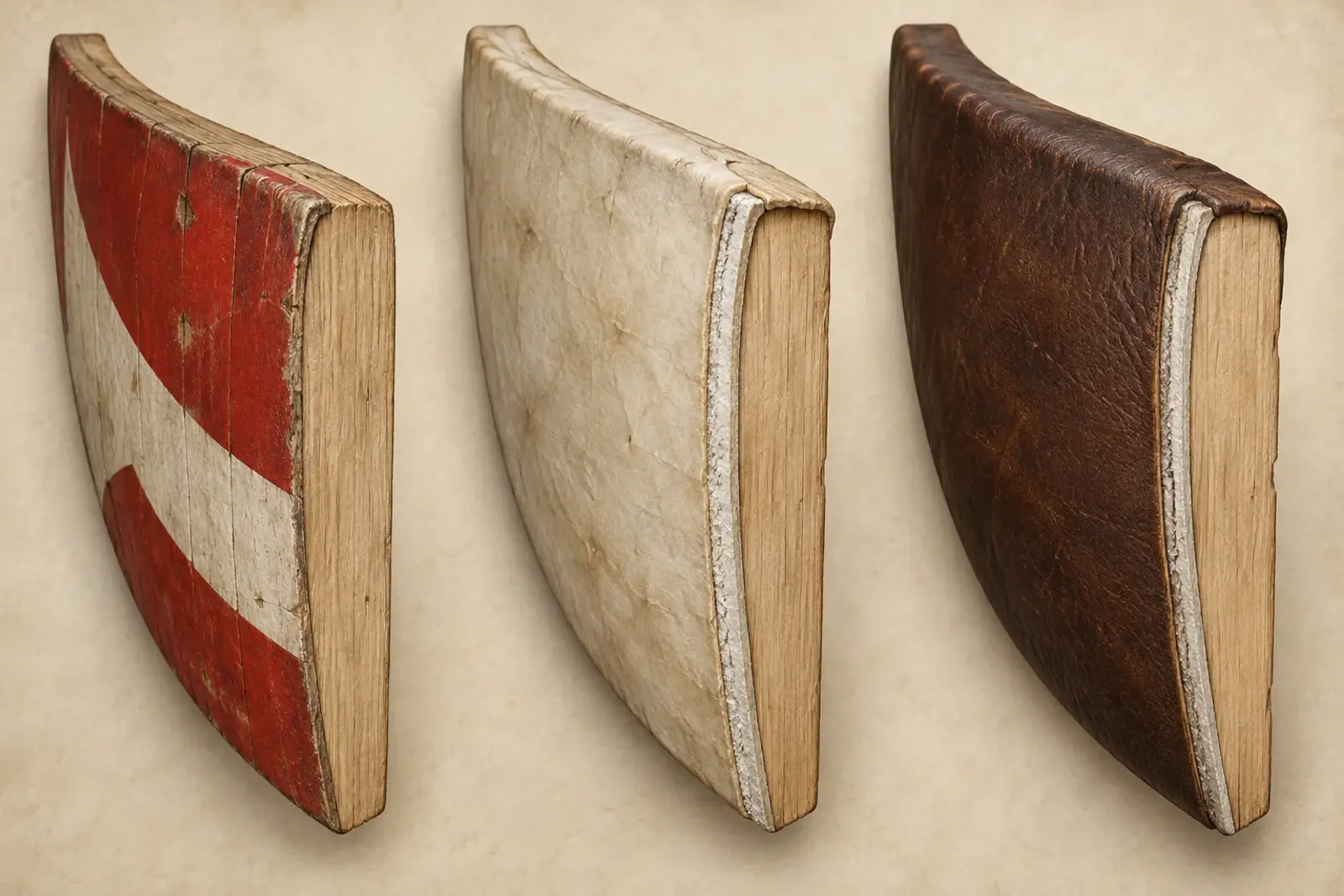
Explanatory comparison of possible shield surface systems: painted wood, parchment or rawhide over wood, and leather over wood. The image visualises categories discussed in the sources; it does not claim that all three were equally documented for every object.Image: Shieldwright explanatory illustration. Generated specifically for this covering article.
Why Cover A Shield At All?
A covering layer could do several jobs at once. It could bind a plank-built surface, provide tensile strength, help control splitting, receive chalk ground and paint, protect the wood, and create a smoother heraldic face. But function has to be inferred carefully from material evidence.
Evidence Comparison
Comparison of the main covering evidence discussed in this article.
Strong evidence for a covered and prepared high-medieval shield surface
Complete rear parchment/leather sequence, originality of rear leather, restoration effects
Konrad von Thuringia shield, Marburg 3177
c. 1230/1240
Linden wood; leather; chalk ground; polychromy in institutional record
Strong material record for a technically prepared painted shield
Detailed parchment arrangement and exact layer sequence need primary wording
Painted Szczecin shield, MNS/A/22250/1
1176-1200
Alder planks and surviving painted decoration
Strong evidence for a painted plank-built shield
Exact surface preparation and whether decoration was directly on wood as conservation proof or catalogue summary
Alfonsine shield-covering passage
Late 13th c.
Horse/donkey hide and cheese paste/glue in a shield-strengthening comparison
Direct textual evidence that hide covering could be associated with strengthening shields
No object-specific identification for Seedorf, Szczecin or Marburg
Linen / textile facing
Medieval craft context; object-specific shield evidence limited here
Practical reconstruction material
Useful for experiments and modern builds
Not yet strong enough as a universal documented 12th-13th c. shield-facing claim
What This Means For Reconstruction
A historically honest workshop programme should test more than one surface system and label each one according to its evidence base.
The best reconstruction is not the one that sounds most medieval. It is the one whose label matches its evidence.
Conclusion
Medieval shield coverings were not a single material hidden under a simple answer. The surviving evidence points to covered, prepared and painted surfaces, but also to object-specific variation and unresolved layer sequences.
A shield covering is not just a material choice. It is a claim about evidence.
Bibliography / Source Base
Senn and Moser. Matthias Senn and Franz Moser, Der Reiterschild von Seedorf UR: ein Untersuchungs- und Restaurierungsbericht, Jahresbericht Schweizerisches Landesmuseum Zurich 100 (1991/1992), 80-85. DOI: 10.5169/seals-395364. Source link.
Rahn. Johann Rudolf Rahn, 1878 examination / 1883 publication tradition for the Seedorf shield, used here for the source-qualified observation of front parchment with chalk preparation and a heavily torn rear leather covering.
Dowen et al. 2019. Keith Dowen, Lech Marek, Slawomir Slowinski, Anna Uciechowska-Gawron and Elzbieta Myskow, Two Twelfth-Century Kite Shields from Szczecin, Poland, Arms & Armour 16, no. 2 (2019), 121-148. DOI: 10.1080/17416124.2019.1667049. Source link.
Muzeum Narodowe w Szczecinie. National Museum in Szczecin, catalogue record for wooden shield MNS/A/22250/1, dated 1176-1200. Source link.
Bildindex / Bildarchiv Foto Marburg. Schild des Landgrafen Konrad von Thuringen, Museum fuer Kunst und Kulturgeschichte der Philipps-Universitaet Marburg, inventory 3177, object record 0001336328; institutional record for date, materials and dimensions. Source link.
Kohlmorgen. Jan Kohlmorgen, Der mittelalterliche Reiterschild: Historische Entwicklung von 975 bis 1350 und Anleitung zum Bau eines kampftauglichen Schildes (2002), used here as technical secondary literature for Marburg and related shield-covering claims.
Warnecke. Friedrich Warnecke, Die mittelalterlichen heraldischen Kampfschilde in der St. Elisabeth-Kirche zu Marburg (Berlin, 1884), used here only as older source-chain evidence for Marburg technical descriptions, not as unchecked modern conservation proof.
Nickel. Helmut Nickel, Der mittelalterliche Reiterschild des Abendlandes, FU Berlin dissertation 1958 / Der Herold offprint 1959/60, cited as broader historiography unless direct wording is available for a specific technical claim.
Alfonso X. Libros del saber de astronomia, ed. Manuel Rico y Sinobas, vol. IV (Madrid, 1863), 69; late-13th-century passage comparing hide covering with shield strengthening. Source link.